
Search Lafayette County Obituaries
Lafayette County obituary research works best when you treat the county office, the state office, and the historical record set as one path. A notice can give you a name, a place, and a rough date, but the record office decides where the certified copy lives. That may be the local Register of Deeds, the Wisconsin Vital Records Office in Madison, or an older death registration held on microfilm. Start with the county name, the year range, and the exact wording from the obituary. Then move to the office that matches the date and the kind of copy you need.
Lafayette County Obituary Sources
The Wisconsin State Law Library directory is the most useful local map for Lafayette County obituary work. It lists the Lafayette County Register of Deeds at (608) 776-4838 for birth, marriage, and death records, real estate records, termination of decedent's property interest, and firm-name registration. It also lists the County Clerk, Clerk of Courts, Register in Probate, and Sheriff. That matters because an obituary may lead to a probate file, a court record, or a family-law paper trail instead of another vital record.
The directory image below points to that office map: Lafayette County State Law Library directory.
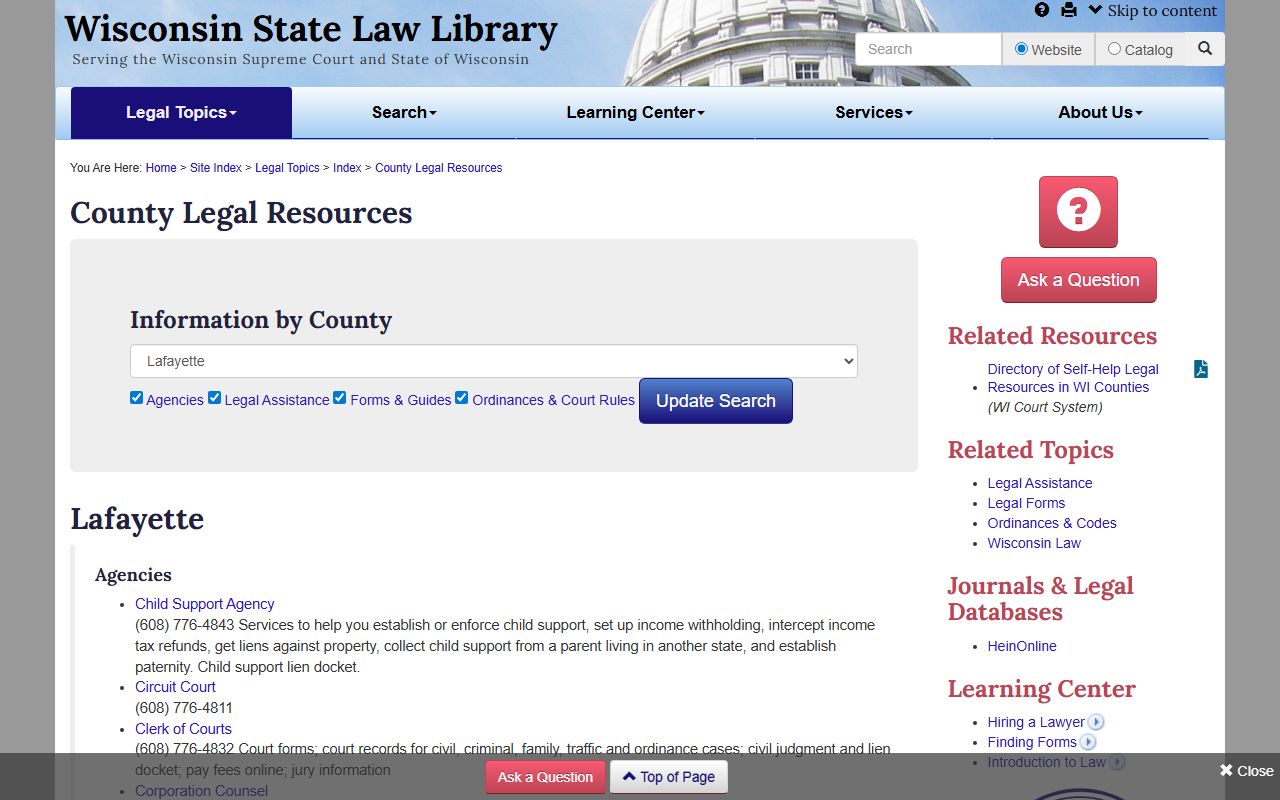
That image is useful because it shows the county office structure in one place and keeps the search grounded in official contact points.
The Wisconsin Department of Health Services adds the statewide layer. Its Vital Records Office handles death certificates and other Wisconsin vital-record requests for events that occurred in Wisconsin. Requests can be made by mail, through VitalChek, or by phone, and the office in Madison serves as the backup when a county desk is not the right place for the record. For a Lafayette County obituary search, that statewide support matters when the date is modern but the local office does not hold the copy you need.
The state office is here: Wisconsin DHS Vital Records.
Older death work can move into the Wisconsin Historical Society and UW Digital Collections. The death-registration finding aid shows Lafayette County death registrations on Reel 32, volumes 1 and 2, covering 1876 through 1907. Those entries can include the name, race, sex, occupation, place of birth, age, parents, spouse, date, place, cause of death, burial place, and the name and address of the person who submitted the certificate. That is a strong match for obituary work, especially when the newspaper notice is short.
The historical collection is here: Wisconsin Historical Society death registrations.
Lafayette County Obituary Requests
Lafayette County obituary requests start with the right office and the right form. The state law library directory points you to the Register of Deeds, and the county form directory shows that Lafayette County uses the county vital-record applications for birth, marriage, and death certificates. That is the practical path for a certified copy. If the record is older or stored statewide, the Wisconsin Vital Records Office can take the request by mail or VitalChek. Either way, the key is to match the request to the record date before you send it.
The county forms directory is here: Wisconsin State Law Library vital records directory.
Before you submit a Lafayette County obituary request, gather the core facts that help the office find the right record. A clear date range saves time. So does the exact name used in the notice. If the person used a nickname in print, include the legal name too.
- Full name from the obituary
- Date or approximate date of death
- Whether the death occurred in Lafayette County
- A mailing address for the return copy
- Photo ID if you need a certified copy
The county directory also shows that Lafayette County has legal assistance and victim support contacts through Family Advocates, Free Legal Answers Wisconsin, and the Lafayette County Victim/Witness Assistance Program. Those are not part of the obituary itself, but they can matter when a death record search expands into probate or another court matter. A family may need help with estate paperwork, and the office list gives you a place to start.
Lafayette County Death Records
The historical death registrations are the best way to push a Lafayette County obituary search past the newspaper clipping stage. The finding aid says the county death books cover 1876 through 1907, and the entries were indexed on microfilm by reel and volume. That matters because the record can fill in the names of parents, a spouse, or a burial place that the obituary left out. It can also confirm the exact year when a family line moved through the county.
Early death records are not always complete. Before 1897, filing was limited to deaths where a physician was in attendance, so some entries are missing details. Then, in October 1907, registration moved into the State Bureau of Vital Statistics. That change is important in Lafayette County obituary research because it explains why some years have rich records while others feel thin. The archive itself tells you where the gap begins and why it exists.
For family history work, the historical registration is often the bridge between an obituary and the people named in it. If the notice says only a married surname, the death registration may show the spouse and the parents. If the notice is brief, the burial place and the reporter name can point you toward a cemetery record or a probate file. The historical collection is not the final answer, but it is often the one that makes the rest of the search possible.
Lafayette County Obituary Research
The county office list from the State Law Library is also the best map for the next record question after a death notice. The Register of Deeds handles vital records and termination of decedent's property interest. The County Clerk handles marriage licenses and elections. The Clerk of Courts handles civil, criminal, family, traffic, and ordinance records. The Register in Probate handles estates and trusts, guardianship, and probate. If an obituary mentions an estate, a surviving spouse, or a child, those office names help you keep the search moving.
That same directory shows the county's legal support resources. Family Advocates, Free Legal Answers Wisconsin, and the Lafayette County Victim/Witness Assistance Program can matter when a record search becomes part of a larger family or court issue. Those contacts are not there to replace the county office. They are there to help you understand where the next piece of paper lives and who can explain the procedure.
The law library forms page is also useful because it links the Lafayette Register of Deeds applications for birth, marriage, and death certificates. When a county page gives you the form, the office, and the contact number in one place, the search gets simpler. That is the right way to handle obituary research. Keep the record trail narrow, and use the official office list instead of chasing broad summaries.
Lafayette County Obituary Access Rules
Lafayette County follows the same Wisconsin Chapter 69 rules that govern certified vital records across the state. Certified copies depend on direct and tangible interest. Uncertified copies are broader, but they are not the same thing. That distinction matters when you are using an obituary for estate work, identity support, or another formal purpose. A newspaper notice can help you find the person. It does not replace the certificate.
Wis. Stat. § 69.20 explains who can receive a certified copy: Wis. Stat. § 69.20. Wis. Stat. § 69.21 explains copies of vital records: Wis. Stat. § 69.21. Wis. Stat. § 69.22 sets the fee structure: Wis. Stat. § 69.22. The RCFP guide puts those rules into plain language: Wisconsin open-government guide.
That legal framework is what separates a request that can be filled right away from a request that needs more proof. It also explains why the county or state office may help you locate a death record but still limit the kind of copy you can receive. For Lafayette County obituary research, that is normal. The notice is public. The certificate follows the statute.