
Search Rusk County Obituary Records
Rusk County obituary records usually begin with a death notice and then move toward the office that can prove the event. In Rusk County, the Register of Deeds is the official repository for real estate and vital records, and it records birth, death, and marriage certificates for events that occurred in the county. The courthouse office in Ladysmith accepts in-person, mailed, and authorized VitalChek requests. For older family searches, the historical record trail can reach back into the mid-1800s. That makes the county office and the state collections equally useful when a name is all you have.
Rusk County Obituary Overview
Rusk County Obituary Sources
The official Rusk County Register of Deeds page says the office is the county repository for real estate and vital records. That matters because an obituary search often ends with a certificate, not just a notice. The office maintains birth, death, and marriage certificates for events that happened in Rusk County, so a family name from a newspaper can turn into a local record very quickly. Start with the county office when the death was recent or when you already know the event happened in the county.
The Wisconsin State Law Library county page is the better backup when you need a plain office map instead of a broad search site. It lists the Register of Deeds as the custodian of birth, marriage, and death records, and it notes that genealogy and historical records date back to the mid-1800s. That is useful in Rusk County because older obituary work often needs a path to the original registry, not just a modern certificate. The state page also helps when the same family name shows up in both county records and historical collections.
The image below comes from the authorized Rusk County VitalChek ordering page: Rusk County VitalChek ordering.

That route is useful when you want the county's own ordering path instead of a third-party resale site.
Rusk County Obituary Requests
Requests in Rusk County can be made in person, by mail, or through authorized VitalChek. The standard Wisconsin fee is $20 for the first certified copy and $3 for each additional copy of the same record ordered at the same time. That fee structure is set statewide, so the county office does not invent a separate copy price just because the record is local. If the obituary is recent and the family needs proof, the county office is usually the shortest route.
The Wisconsin Department of Health Services is the statewide fallback for records from October 1907 to the present. It says birth, death, and marriage records can be ordered through county Register of Deeds offices or through the state office in Madison. That is helpful when the Rusk County office is closed, when the event is outside the county range, or when the request is being handled from another part of Wisconsin. VitalChek is the authorized online and phone vendor, but the state office still runs the records program.
When you send a request, keep it focused:
- Full name from the obituary or death notice
- Approximate date of death
- Rusk County town, village, or township
- Photo ID or proof of direct and tangible interest when needed
That short list is enough for most local requests and it keeps the office from having to guess which person you mean.
Note: The state fee is fixed, but VitalChek adds its own service charge, so online ordering can cost more than a mail request.
Rusk County Obituary Archives
Older Rusk County obituary work often starts with the Wisconsin Historical Society pre-1907 index rather than the county office. The pre-1907 index covers Rusk County, and the society explains that statewide registration was not uniformly maintained before 1907. That means some names appear in the index, while others survive only in extant records held by the Historical Society. When a notice looks incomplete, that older archive can supply the dates, parents, spouse, or burial details that the newspaper left out.
The Wisconsin Historical Society obituary collections and the broader Wisconsin Historical Society portal are the next good step when a death notice is more useful than a certificate. The obituary collections page gathers obituary articles and scrapbook material, while the portal adds searchable records, newspaper clippings, and other local history tools. If you want newspaper coverage beyond the county file, Chronicling America can also help you search Wisconsin papers for death notices and obituary reprints. That broader search is often what connects a family line to the right town and date.
The image below comes from the Wisconsin State Law Library Rusk County directory: Rusk County legal resources directory.
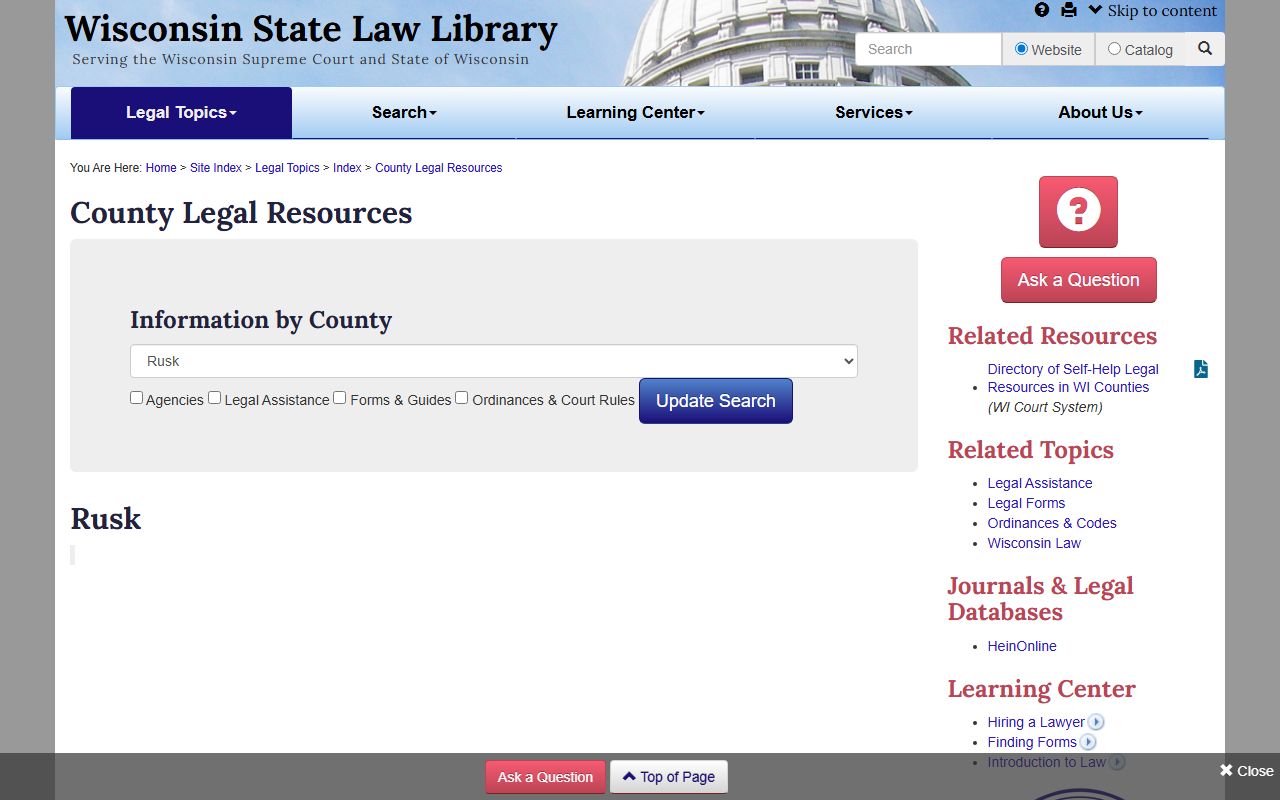
That directory keeps the search grounded in official offices when the obituary clue points to more than one county function.
Rusk County Obituary Access Rules
Wisconsin Chapter 69 controls the record path. Wis. Stat. § 69.20 limits certified copies to people with a direct and tangible interest, while Wis. Stat. § 69.21 explains certified and uncertified copies. Wis. Stat. § 69.22 sets the copy fees, and the RCFP Wisconsin open-government guide explains why a public obituary and a certified death record are not the same thing.
That split matters in Rusk County because the record you can read and the record you can use for proof are different products. A newspaper obituary may be enough for a family history file. A certified death certificate is the document for benefits, estate work, or a formal identity check. When the death is recent, the county office or Wisconsin DHS is usually the fastest official path. When the death is old, the Historical Society index and obituary collections can be the better first stop.
For Rusk County obituary research, keep the county office, the state office, and the historical collections in that order of thought. That keeps the search tied to the right record type instead of drifting into generic web results.
Note: For older Rusk County obituary searches, the Historical Society is often the best first index, then the county office can supply the certified copy if one exists.